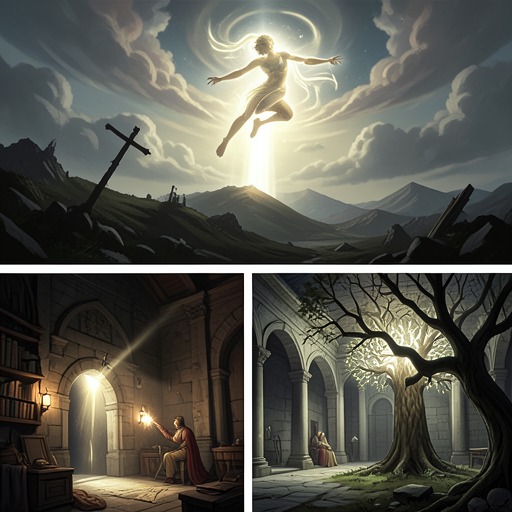
Cross of Christ
Paradise LostThe Cross of Christ is the central object of the poem’s redemptive design. It is not merely the site of the Messiah’s execution but the material sign of a life-for-life exchange: the Son of God assumes human nature, accepts the penalty incurred by Adam and his posterity, and transforms an instrument of shameful death into the means by which death itself is overcome.
Definition and Redemptive Function
The Cross is presented as the place where the Son of God will endure the punishment that Adam cannot pay. After disobedience, humanity has forfeited life and stands subject to death and Hell; no heavenly being volunteers to bear that “deadly forfeiture” until the Son offers himself as the substitute. He proposes to leave the bosom and glory of the Father, become man, and accept death on behalf of mortal humanity. The Cross therefore embodies both the severity of the law and the generosity of divine grace: justice receives the required satisfaction, while humanity receives a deliverance it cannot achieve for itself.
The object’s meaning depends on the Son’s willing self-offering. He does not merely suffer an imposed fate; he presents himself as a sacrifice, asking that the Father’s anger fall upon him and declaring himself content to die for humanity. His mortality is temporary because he possesses life in himself through the Father. Death may claim what in him can die, but it cannot retain his unspotted soul in the grave. The Cross thus becomes the point at which voluntary obedience converts punishment into atonement and apparent defeat into the condition of victory.
The Crucifixion Foretold
The Archangel Michael explains the Cross to Adam as the fulfillment of the obedience lacking in Adam and required by the law under penalty of death. The future Redeemer will unite Godhead and manhood, live among men, and fulfill the law through obedience and love. Love alone is said to fulfill the law, but the Redeemer must also endure the punishment due to Adam’s transgression and to the sins that will grow from it.
Michael’s prophecy gives the Cross a sequence of humiliation and violence. The Redeemer will live hated, be blasphemed, seized by force, judged, condemned, and nailed to the Cross by his own nation. His death is shameful and accursed in its outward form, yet it brings life to those who believe in his redemption. The contrast is essential: he is slain precisely for bringing life, and the Cross displays how the most degrading public death can become the means of universal benefit.
The prophecy also specifies that the Redeemer’s obedience will be imputed to believers. Their salvation will not rest on their own legal works, but on faith in his satisfaction, a faith that is not empty of works. The Cross therefore links an objective act of punishment-bearing with a transformed human response: those who receive its benefit must embrace life by faith and live in relation to the Redeemer’s merit rather than relying on their own righteousness.
Defeat of Sin and Death
The Cross is the battlefield on which the powers governing the fallen condition are disarmed. The Son does not defeat Satan by simply destroying Satan. Instead, he defeats Satan’s works in humanity, answering the wound inflicted on human nature through obedience and suffering. On the Cross he nails the law that stands against humanity and the sins of mankind together with himself, so that they can no longer injure those who rightly trust in his satisfaction.
This action reverses the apparent logic of the Fall. Adam’s disobedience brings guilt and death upon his descendants; the Son’s obedience creates a second root from which restoration becomes possible. The Cross is therefore both judicial and organic: it satisfies a penalty, but it also establishes a new source of life. The same humanity that perishes in Adam can be restored in the Son, and none is restored apart from him.
The victory reaches beyond the moment of crucifixion. The Son rises before the third dawn, and Death, which seemed to possess him, loses its power over him. Michael describes the Redeemer’s death for those who receive life as resembling sleep, a temporary passage toward immortality rather than final annihilation. The Cross consequently changes the status of death itself: death remains a real penalty, but for the redeemed it becomes a passage that cannot finally hold them.
Aftermath and Universal Reach
Following resurrection, the Redeemer will appear to his disciples, who are charged to teach all nations and baptize believers in the flowing stream as a sign of cleansing from guilt into pure life. The Cross therefore initiates a historical mission extending beyond the descendants of Abraham by blood. Salvation will be preached to the descendants of Abraham’s faith throughout the world, so that all nations may be blessed in his seed.
The Cross also precedes ascension and final judgment. The Son will ascend triumphantly through the air, bind and confound the Serpent, enter glory, and resume his seat at God’s right hand. From there he will return when the dissolution of the world is ripe, judging the unfaithful dead and rewarding the faithful. Its consequences thus extend from the immediate remission of human guilt to the final reordering of creation, when the Earth will become a paradise happier even than Eden.
Paradox and Thematic Significance
The Cross concentrates the poem’s governing paradoxes: life emerges through death, victory through apparent defeat, justice through substitution, and good from evil. Adam recognizes that the promised redemption may produce more good than the Fall produced harm, bringing greater glory to God and allowing grace to abound over wrath. The Cross is the material and narrative hinge of that reversal, the point where the consequences of disobedience are neither denied nor simply erased but answered by an act of superior obedience.
Its imagery also clarifies the poem’s economy of debt and payment. Humanity has nothing adequate to offer for its own atonement; the Son supplies the “life for life” that no other heavenly power will risk. Yet the exchange is not presented as a commercial bargain between equals. The Son gives himself freely, grace arrives unprevented and unsought, and the value of the payment lies in the divine love and obedience embodied in the giver. The Cross therefore joins strict satisfaction to unmerited mercy, making redemption possible without treating sin as inconsequential.
The object’s final significance lies in its double orientation. It looks backward to Adam’s failed obedience and the mortal condition that follows, while looking forward to resurrection, ascension, judgment, and the restoration of the Earth. In that temporal span, the Cross turns the Fall’s instrument of condemnation into the foundation of restoration: the place where the Son bears death, defeats its power, and makes immortal life available to those who receive his redemption.